



Composing a song online is a much more accessible and magical adventure than you might imagine. Do you have that melody floating around in your head, that little spark of an idea just waiting to ignite? Today, all you need is a computer and an internet connection to transform it into a real song, from the comfort of your living room.
Overcoming the myth of the inaccessible studio
Let's be honest: when we think of music composition, we often imagine expensive studios, impressive mixing consoles, and endless technical equipment. This vision, which was once a reality, is now a distant memory. It's time to let go of this psychological barrier that may be holding you back.
Today, your greatest asset is your creativity. Online platforms have opened the doors of musical creation to everyone, not just a handful of professionals. It's a true revolution that has reshuffled the cards for all artists who, like you, have a story to tell.
This transformation of the music world is very real. In France, the digital music sector has literally exploded. To give you an idea, in 2005, revenue barely reached 39 million euros. In 2023, it climbed to exceed 620 million euros , a growth driven largely by streaming and online sales. These figures clearly show that composing and sharing music on the internet has become a real phenomenon. For those interested in numbers, the data from the music industry in France is quite telling.
Adopt a new creative mindset
The real trigger for starting online composition isn't technical; it's primarily in your heart and mind. It's about approaching creation with curiosity and a desire to experiment. Let go of the idea that you have to create a masterpiece the first time. The goal is to have fun, play with sounds, and see where your inspiration takes you.
Think of digital tools as play partners, not obstacles. They're there to help you:
- Explore sounds you never imagined using.
- Organize your ideas visually and intuitively.
- Go back and correct your “mistakes” without any pressure.
Your first composition probably won't be the hit of the year, and that's absolutely fine. What really matters is taking that first step, creating something that's truly you, and feeling the immense satisfaction of having followed through on an idea.
Your starting point to creation
With this new approach, you free yourself from the fear of doing something wrong. Each session becomes an opportunity to learn and improve. You'll soon realize that the process is much more instinctive and rewarding than you might have thought.
This guide has a simple mission: to give you the confidence and the keys to turn that melody playing on repeat in your mind into a song you'll be proud of. The adventure has only just begun.
Building your first virtual home studio
Getting started with online composition can seem as daunting as finding yourself in front of a huge library and not knowing which book to open. You see all these possibilities, and you wonder where to start. But rest assured: you don't need to read everything to write your own story. The secret is to find the few tools that really speak to you.
Your first home studio doesn't have to resemble an airplane cockpit. Far from it. The idea is to assemble a small creative arsenal that will allow you to transform your ideas into sounds. Forget endless equipment lists. We're going to focus on the essentials so you can compose a song online in a smooth and inspiring way.
It often starts here: a simple laptop. It becomes the centerpiece of your creative space.
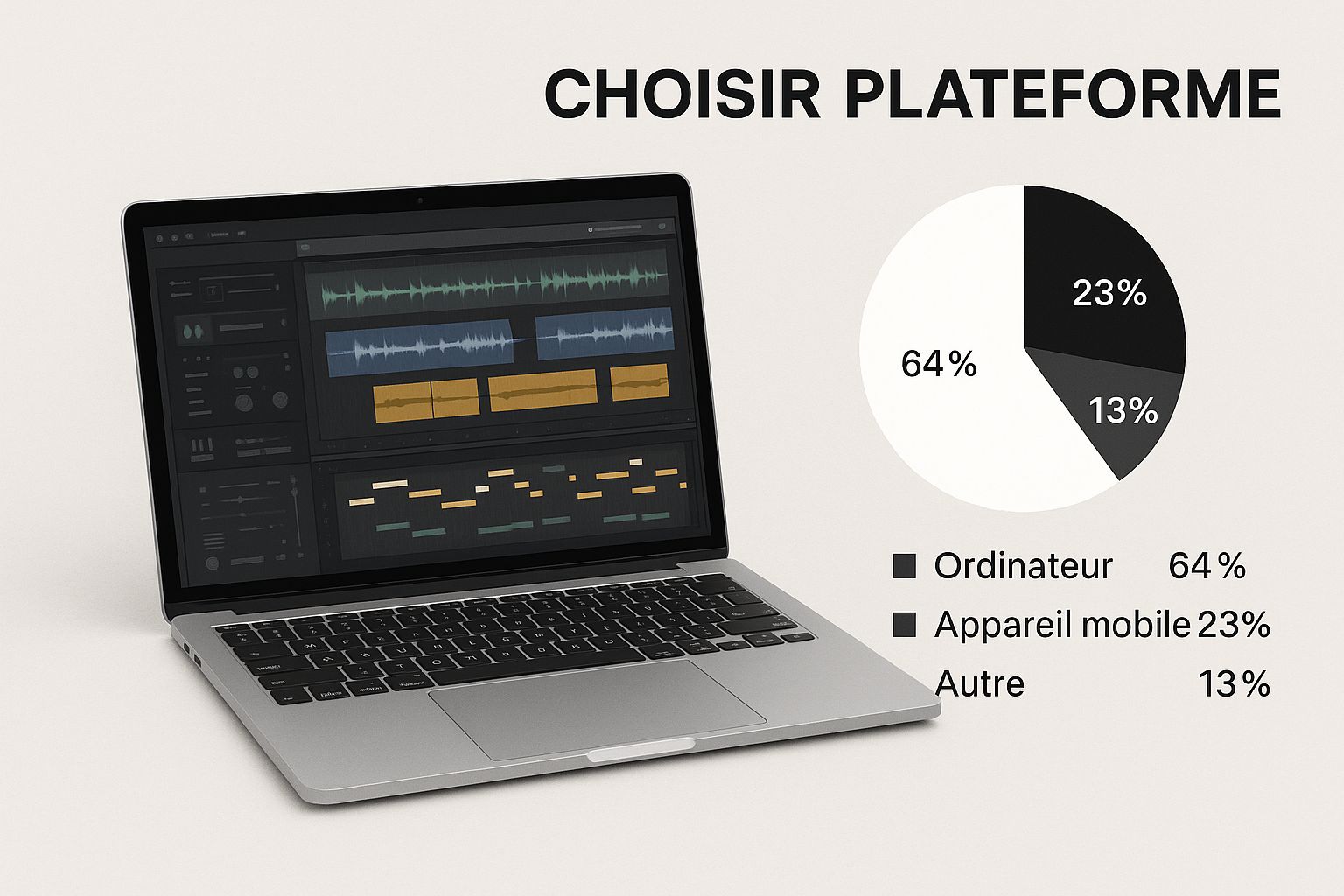
This visual clearly shows that the interface and ease of access are often the first criteria for choosing the right platform and building your little virtual creative corner.
The basic building blocks of your studio
To get started, three elements are essential. Think of them as your Swiss Army knife of music creation. Each tool has its role, but together they work wonders.
First, the digital audio sequencer , or DAW ( Digital Audio Workstation ). This is the heart of your studio, your blank canvas. Online solutions like BandLab or Soundtrap are great for getting started. They're free, often collaborative, and include everything you need to record, arrange, and mix with ease.
Then there are virtual instruments (VSTi) . These are simply software programs that mimic real instruments: pianos, synthesizers, drums, violins... Most online sequencers offer a nice basic selection, more than enough to lay out your ideas and build a solid model. Some sites like Spitfire Audio even offer free orchestral sound banks of breathtaking quality.
Finally, sound banks and loops . These are real gold mines for finding inspiration. They are collections of pre-recorded sounds—a drum beat, a guitar chord—that you can drag and drop into your project. It's a great way to start a song, especially when you don't have an instrument handy.
My heartfelt advice: don't accumulate dozens of tools. The secret is to master the ones you choose. Take the time to thoroughly explore a single sequencer, to get to know its sound library and instruments well. This familiarity will unleash your creativity much more effectively than a mountain of options you only half know.
How to choose the right tools for you
The best tool is the one that fits your style and your way of creating. Don't be intimidated by what the "pros" use. The important thing is that the tool feels natural, almost like an extension of your thoughts.
- If you're more of a songwriter or singer : Look for a platform where vocal recording is simple and straightforward. A clean interface with a few good basic effects, like reverb or delay, can really elevate a vocal take.
- If you're a beatmaker at heart : Choose sequencers with a good drum machine and a large drum sound bank. Ease of creating and manipulating loops will be your priority.
- If you're a melodist : Do you think primarily in terms of chords and melodies? A good MIDI editor and a varied selection of virtual instruments (piano, strings, synths) will be your best allies.
To help you see things more clearly, here is a brief comparison of the main families of tools available.
Comparison of the types of platforms for composing online
This table compares the main categories of tools for online music composition, to help you choose the solution best suited to your needs and level of experience.
| Platform type | Ideal for... | Benefits | Disadvantages | Examples |
|---|---|---|---|---|
| Online sequencer (DAW) | Beginners and collaborative projects. | Accessible everywhere, often free, easy to use, sharing functions. | Less powerful than dedicated software, depends on internet connection. | BandLab, Soundtrap, Soundation |
| Desktop DAW software | Serious creators and professionals. | Maximum power, total control, huge plugin ecosystem. | High learning curve, often expensive, requires a powerful computer. | Ableton Live, FL Studio, Logic Pro |
| AI Music Generator | Content creators, people looking for quick inspiration. | Very fast, generates ideas instantly, no musical knowledge required. | Little creative control, sometimes generic results. | Suno, Amper Music |
| Sample/Loop Platforms | Beatmakers, producers and musicians looking for sonic textures. | Huge library of high-quality sounds, an inexhaustible source of inspiration. | Can get expensive (subscription), may sound like other productions. | Splice, Loopcloud |
This table should give you a good basis for your choice. The most important thing is to find the tool that inspires you to create, without feeling overwhelmed.
Exploring these different options is already part of the creative process. To go further and see how all these elements come together in practice, don't hesitate to consult our detailed guide which shows you how to create a custom song with step-by-step examples.
From idea to first demo: bringing your song to life
This is where the magic happens. That moment when the silence crumbles to make way for the music. Your idea, that little creative spark, will finally take shape and become a model, a true sound sketch.
Let go of the pressure of achieving perfection. For now, the goal is much simpler and just as rewarding: building a solid foundation, a foundation upon which your song can grow and flourish.
The journey to composing a song online almost always begins with a small, tiny detail. Sometimes it's a sequence of four chords played tentatively on a virtual piano, other times a catchy bass line stuck in your head. It might even be a simple melody hummed quickly and recorded on your phone. Regardless, this initial fragment is the skeleton of your future song.
Building the structure of your piece
Once you have this first element, you need to give it a structure. Think about it: most of the songs we love follow a fairly similar architecture, a sort of blueprint that guides the listener's ear. We often find the classic structure:
- The intro: An appetizer that sets the mood and prepares the ground.
- The verse: This is the narrative part, where the story unfolds.
- The chorus: The beating heart of the song, the most memorable and catchy part, the one that comes back.
- The bridge: A moment of breathing space, a transition that brings a new color or another perspective before the grand finale.
- The outro: The conclusion, which can be a repetition of the chorus that fades out or a very last musical idea to bring things full circle.
Don't be afraid to use this structure as a GPS. It's not there to lock you in, but rather to give you a reassuring framework that helps organize the flow of ideas.
How to escape the infinite loop trap?
One of the biggest challenges when you're starting out is getting stuck in what I call the "eight-bar loop." You come up with an idea that sounds great, and you're playing it over and over again, with no idea how to evolve it. It's frustrating.
The secret to success? Think in terms of tension and release . Your piece must live, breathe, and tell a story. To do this, you need to create variations.
Here are some tips I use all the time to get a model off the ground:
- Play with density. Bring instruments in and out. For example, start the first verse with just piano and vocals, then blast the drums in the first chorus to create a real impact.
- Introduce new elements. A small, discreet synth arpeggio that slips into the second verse, or a subtle string lick that appears in the bridge... these little details make all the difference.
- Vary the rhythms. Change the drum pattern between the verse and chorus. A more stripped-down rhythm in the verse leaves more space for the vocals, while a punchier groove in the chorus will increase their energy tenfold.
Thinking in terms of motifs and development is a technique that has a long history. As composer Aaron Paris said, "Classical music is based on taking ideas, motifs, fragments, and developing them to tell a story." This is exactly what you're doing on your scale with your model.
Setting the scene: your first model step by step
Let's imagine a concrete scenario. You've hummed a simple melody into your phone. Here's how you could transform it into a structured demo.
First, the skeleton . Import your vocal recording into your software. Look for the chords that naturally accompany it on a virtual piano. That's it, you have your chord progression.
Next, the rhythm . Add a simple bass line, following the root notes of your chords. Then, program a basic drum rhythm: a kick on beats 1 and 3, a snare on beats 2 and 4. The basics.
Now it's time to build the structure . Duplicate your loop to create the different sections. For the chorus, why not add a shaker or tambourine to boost the energy? For the bridge, remove the drums and keep only the piano and a synth pad for a more airy atmosphere.
Finally, enrichment . Lay a first version of your voice over this structure. Don't dwell on perfection; it's just a guide. Listen to it all and ask yourself the right question: "At what point does it become repetitive?" This is precisely where you will intervene, by adding a small variation, a new instrument, or even a well-placed silence.
At the end of this process, you won't have a finished product ready for release. You'll have something much more valuable: a coherent demo that already tells a story. It's tangible proof that you can compose a song online from scratch.
Words that sound like you
A song, at its core, is much more than just a melody. It's a story, a confidence, a memory brought to life and hopefully resonated with someone else. It's this delicate marriage of words and music that can transform a simple idea into an unforgettable moment.
To write an online song that resonates with its audience, the first step isn't to strive for the perfect rhyme at all costs. It's to draw on what's true, what's unique to you. Your experiences, your emotions, your unique way of seeing things... that's where your raw material lies.
Drawing inspiration from reality
Inspiration isn't a mystical gift reserved for a select few. It's everywhere, lurking in the little things of everyday life. A phrase caught on the bus, the color of the sky on a summer evening, a childhood memory that resurfaces... Everything is material for a song.
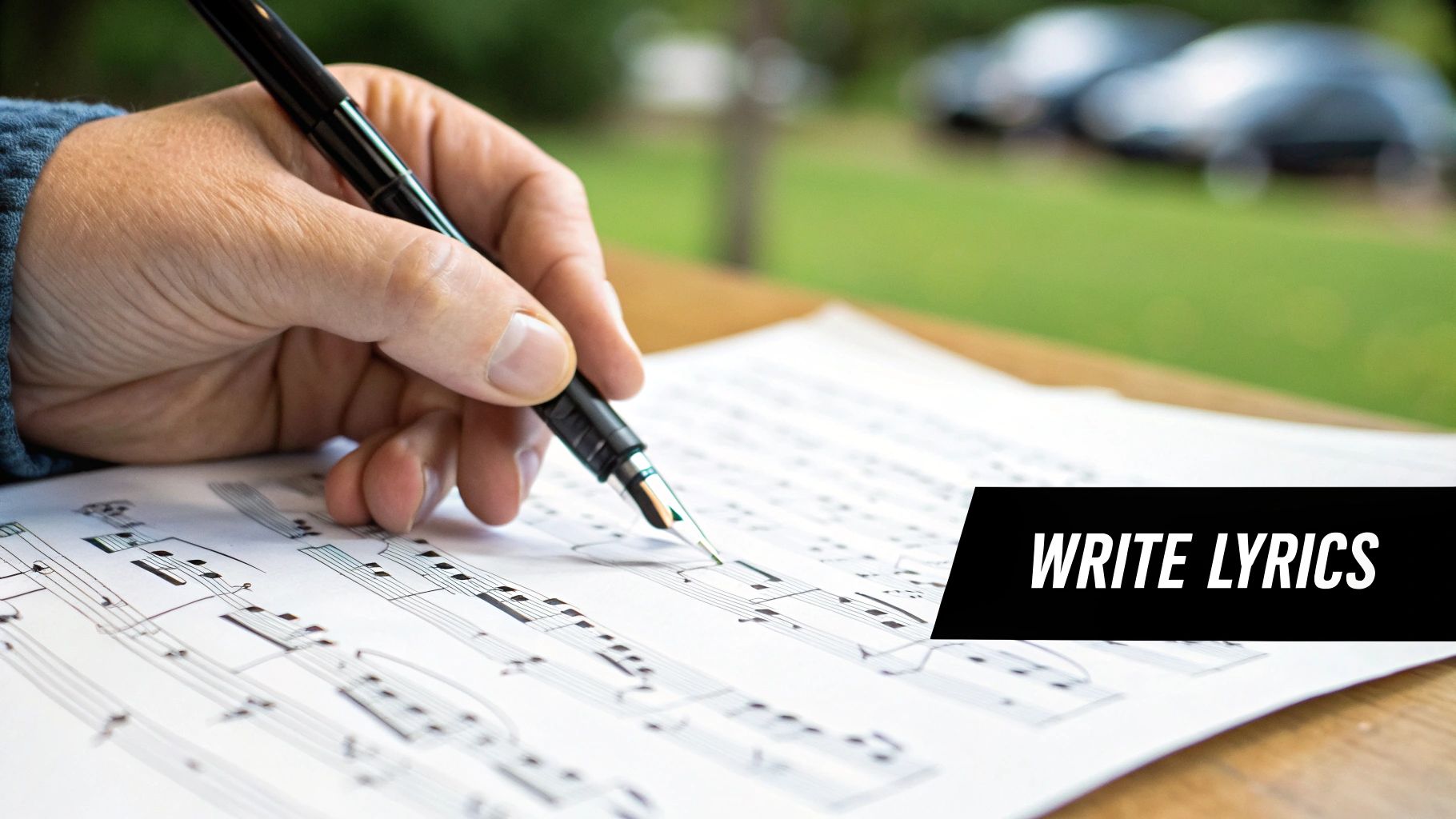
My advice? Always keep a notebook with you, or a simple note on your phone. Capture those fragments of ideas, those words, those images before they escape. The goal isn't to write a poem worthy of Baudelaire, but to tell a story with authenticity. Use your own words, your own expressions. It's often more touching than perfectly crafted but soulless prose.
What makes a song memorable is that feeling that it was written just for us. She achieves this by using concrete imagery and simple language to touch on universal emotions. It's this intimate connection that creates the magic.
Giving a voice to your words
Once your lyrics begin to take shape, it's time to find a voice for them. The melody of a song isn't just a vehicle for the lyrics; it's a layer of emotion in its own right. Think about it: the same phrase can express joy, nostalgia, or anger, depending on how it's sung.
Don't be afraid to experiment. Grab your instrumental demo and hum your lyrics along with it. Don't judge yourself, just let yourself go. Experiment with different intonations, vary the rhythm of the words, find the right places to breathe and give weight to a key phrase. It's often in these subtle details that the secret to a catchy melody lies.
Here are some concrete ideas for sculpting a vocal line with character:
- The power of silence: A brief pause just before an important word can multiply its impact. It's a classic, but it works every time.
- The play of contrasts: If your verses are sung in a rather calm and narrative manner, a soaring chorus will create a surprise effect and a captivating dynamic.
- Phrasing: How you "say" the words while singing is crucial. Try singing a phrase very haltingly, then very smoothly. You'll see, the feeling changes completely.
For example, telling a love story isn't just about writing "I love you." It can be about describing a small physical detail that melts your heart, or evoking a specific memory shared by the two of you. If you're looking for ideas on how to approach this theme, techniques for expressing love through song can help you find a personal and original angle.
Ultimately, writing lyrics and a melody is a bit like engaging in an intimate conversation. You share a part of yourself, with the hope that someone, somewhere, will recognize themselves in your words. It's this invisible exchange that is the true heart of a successful song.
Add the finishing touches and share your creation
That's it, your song has come to life. It has a structure, instruments, and a voice. Congratulations! You've done the hardest part and already have something unique in your hands. But before you shout it from the rooftops, there's one essential step left: that famous polishing that will take it from "good demo" to "great song."
This finishing phase can be intimidating, it's true. We often hear technical terms thrown around that can be a bit scary. Don't worry, you don't need to be a sound engineer to give your track the polish it deserves. The idea is simply to make sure all the elements of your song fit together perfectly, like the pieces of a sonic puzzle.
Online mixing, easier than it seems
Mixing is simply the art of perfectly balancing each sonic ingredient. Think of a chef adjusting the salt, pepper, and spices to create a perfectly balanced dish. Here, it's the same: you'll adjust the volume and presence of the drums, bass, piano, and your voice to create a harmonious whole.
Most online songwriting tools offer basic mixing functions. To get started, focus on two basic settings:
- Equalization (or EQ) : This is your best friend when it comes to shaping your sound. EQ acts like a filter that allows you to boost or cut certain frequencies (bass, mids, treble) on each track. Is your voice a little masked by the piano? Try lowering the piano's mids slightly to give it more room. It's magic.
- Compression : This tool is used to even out the volume. It reduces the gap between the loudest and quietest sounds in your track. In practical terms, it makes the sound denser and more impactful. No more vocals that disappear in the soft verses and then saturate in the powerful choruses!
The best advice I can give you? Forget technique for a moment. Close your eyes and trust your ears alone. The goal isn't to achieve theoretical perfection, but to create a sound that you enjoy and that serves the emotion of your song.
Mastering and the big leap: sharing
Once you're happy with your mix, there's one final touch: mastering . This is what will ensure your track sounds great everywhere, whether it's on smartphone headphones, a Bluetooth speaker, or in a car. Fortunately, online services like LANDR or eMastered do a stunning job automatically and at a very reasonable cost.
Your song is now ready to meet its audience! Sharing has become incredibly easy. Today, music is everywhere: in France, we listen to an average of 18 hours and 48 minutes of music per week. Streaming accounts for 60% of the sector's revenue , which shows how natural it has become to distribute your music online. To dig deeper, take a look at these trends in the French music market .
You can start small. Platforms like SoundCloud or Bandcamp are ideal for gathering initial feedback and starting to build a community.
Ready to take it to the next level? Digital distributors like DistroKid or TuneCore will get your track on all the major platforms (Spotify, Apple Music, Deezer) for a small fee. This is where your story with your audience truly begins.
We answer your questions about online composition
Do you have questions about creating music online? That's perfectly normal. When you're just starting out, you're always a little apprehensive. The idea here is to dispel these doubts so you can get started with peace of mind.
Let's dive right into the most common questions creators like you have.
Do you really need to be a music theory pro?
Absolutely not. To compose a song online , you no longer need to master music theory. Today's tools are designed to be visual and intuitive. Many include chord generators or helpers that literally show you what to do.
Your best guide is your ear. Your sensitivity and creativity are the only things you really need. Think of music theory as a bonus, one more tool in your arsenal, but never as a barrier to entry.
Can you really create a song without paying anything?
Yes, absolutely. It's possible to produce an entire song from A to Z without spending a single euro. There are some excellent sequencers (DAWs) directly accessible from your browser, such as BandLab or Soundtrap. They provide impressive libraries of sounds and virtual instruments that you can use freely.
How can I be sure that my song is protected?
Excellent question, and it's an essential reflex to have. Know that your creation is automatically protected by copyright as soon as you materialize it.
To have tangible proof that you are the author, here is what you can do:
- Official deposit : In France, you can deposit your work with an organization such as SACEM.
- Online timestamping : Specialized services can create secure, dated proof of your file's existence at a given time.
Protecting your work means ensuring you maintain control. This is especially important given the booming music market. In 2019, the recorded music sector experienced strong growth of 5.4% , generating total revenue of €772 million . Online platforms have clearly played a role in this dynamic, making creation and distribution more accessible. You'll find more information in this data on the music market .
The world of online music is vast and exciting. If you want to continue exploring the topic, feel free to explore the other articles on our blog .
Do you have a story to tell, an emotion to convey? With YourMelody , transform it into a unique song unlike any other. It's the perfect gift to make an impression and touch the heart. Get started and compose your personalized song now!
Article created using Outrank