




Writing a love song isn't just about putting together pretty rhymes. It's the art of transforming raw emotion—that feeling that grips you—into a story that speaks directly to your heart. The key? Delving honestly into your own memories, choosing a simple structure that serves your message (like the classic verse-chorus), and letting the words and music tell a truth that comes from within you . Put technical perfection aside for a moment. Your greatest asset is your authenticity.
Dive into the heart of inspiration: your story
A lasting love song is always born from pure emotion, never from a ready-made recipe. So, forget writer's block! Together, let's find that little spark deep within you that makes your story absolutely unique. That's where it all starts.

Close your eyes for a moment and think of a specific memory. A scent that transports you, an unforgettable burst of laughter, or even that heartbreak that shaped your relationship. It's in these small details, these fragments of your own life, that the true power of your future song lies. The greatest love songs draw their strength from this disarming authenticity.
French song is living proof of this! Take a monument like Jacques Brel's "Ne me quitte pas," released in 1959. This song spans generations, not for its musical complexity, but for its raw emotional charge. It touches on a universal truth by starting from a deeply personal pain.
What is the message of your song?
Before you even think of the first word, take a moment to connect with your intention. What do you really want to say? Will your song be:
- A passionate declaration, a true cry from the heart?
- A nostalgic whisper, a tender look back at the path you have taken?
- A promise of the future, full of optimism and hope?
This angle will change everything. It will dictate the tone of your voice, your choice of vocabulary, and even the rhythm of your melody. The goal isn't to talk about love in general, but about your love, with its unique colors.
The secret isn't telling a perfect love story, but telling your story with perfect accuracy. It's vulnerability that creates an immediate connection with the listener.
The trick of the emotional "moodboard"
To help you channel all this inspiration, try creating an emotional mood board. It's a simple yet incredibly effective technique for giving your creative process a clear direction. The idea is to gather elements that capture the essence of how you feel.
Concretely, it can be:
- Keywords : List adjectives, action verbs, and nicknames that define your relationship.
- Images : Photos of you, a landscape that reminds you of a magical moment, a screenshot of a touching message.
- Sounds : Music that puts you in the right mood, that evokes the atmosphere you want to create.
With this solid and personal foundation, your song is sure to be touching, as it will come directly from your own life. If you need a little help finding the right words, our guide on how to express your love could give you some valuable insight.
Building the narrative of your song
A love song isn't just a pretty melody and a few sweet words. It's a story! For it to truly touch the heart, it needs a beginning, a middle, and an end. A common thread that carries the listener along on your emotional journey.
Think of it not as hard and fast rules, but rather as the plot of your own romantic movie. The most classic and tried-and-true structure is the verse-chorus-bridge . It's the backbone of most ballads that pop into our heads.
Lay the foundation with the first verse
The first verse is your opening chorus. It should immediately immerse the listener in your world. This is the time to set the scene, establish an atmosphere, and present the feeling that drives you.
Instead of a generic "I love you," try painting a picture. For example, instead of saying "I fell in love from day one," why not sing, "I remember the light / On your hair that winter evening." It's instantly more intimate, right? You're not revealing everything; you're creating a connection, a curiosity.
Your mission here: create an instant hook. The listener should feel engaged, as if they were there, and want to know what happens next.
The chorus, the beating heart of your message
If the verse is the unanswered question, the chorus is the resounding answer! It's the nerve center of your song, the idea everyone should remember. It should be direct, memorable, almost like a slogan you want to sing at the top of your lungs.
The second verse, meanwhile, will enrich the story. It's an opportunity to evoke a shared memory, to show how your relationship has evolved, to add a new layer of emotion.
This image perfectly illustrates how the lyrics flow, from the first draft of ideas to the construction of the verses that gravitate around a powerful chorus.
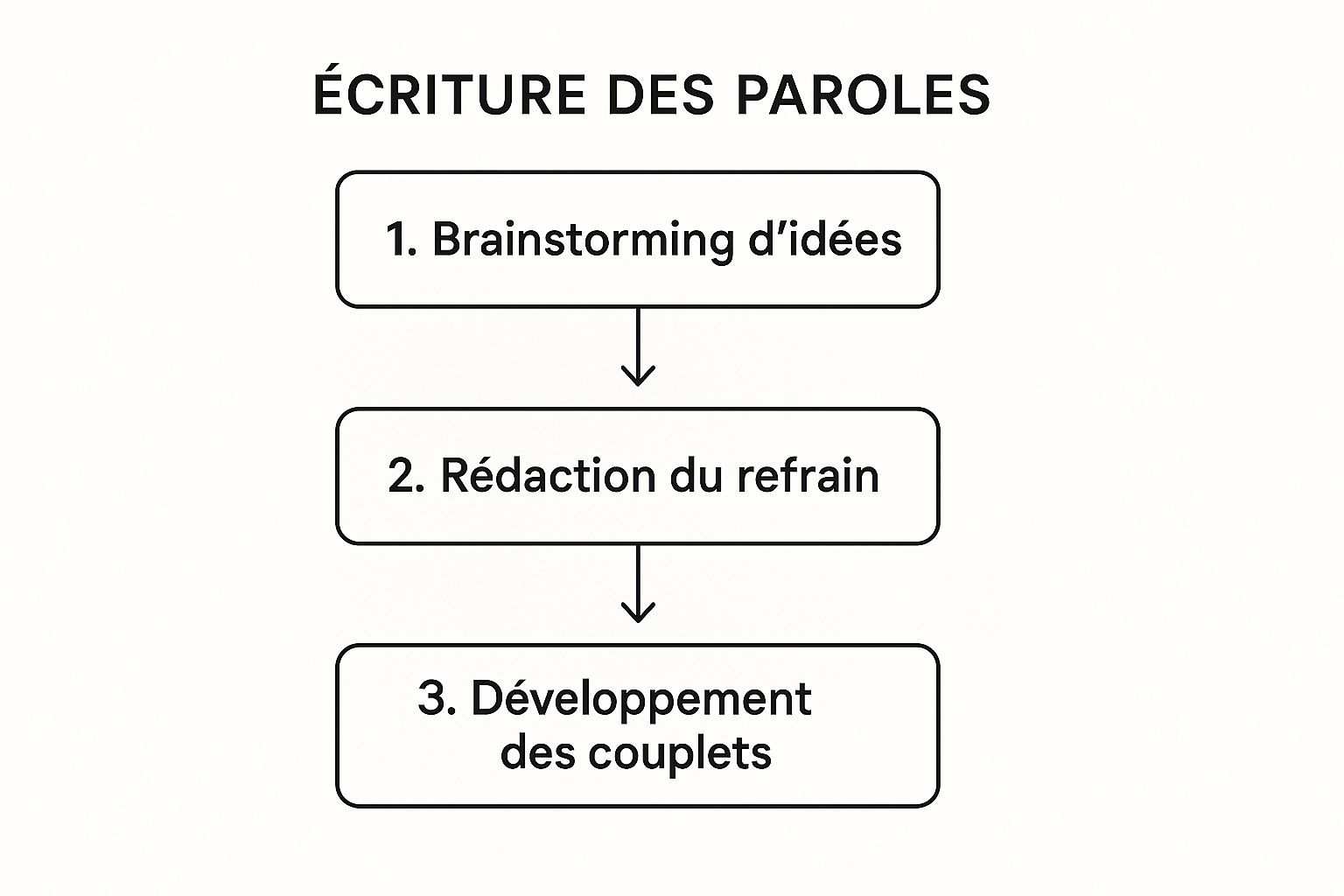
It is clear that the chorus is not a simple repetition; it is the emotional anchor of the entire piece.
The bridge, the twist that changes everything
Ah, the bridge! It's often my favorite moment. It usually comes after the second chorus, and its role is to break the routine. It's the perfect place for a revelation, a realization, or even a moment of doubt. This shift in perspective will give incredible power to the final chorus.
This little break makes the return of the chorus even more satisfying and impactful. It's the chef's touch!
To help you visualize this narrative journey, here is a small table that summarizes the role of each part.
Narrative structure of a love song
This chart breaks down the role of each part of a song in building a cohesive and compelling story.
| Element of the song | Narrative Objective | Writing advice |
|---|---|---|
| Verse 1 | Introduce the story, the context, the initial emotion. | Use sensory details (a smell, a light) to create a strong image. |
| Refrain | Reveal the central message, the main and memorable idea. | Be direct and concise. This is the key phrase to remember. |
| Verse 2 | Develop the story, show evolution, add depth. | Recall a shared memory or a moment that changed everything. |
| Bridge | Offer a new point of view, an emotional break. | Ask a question, express a doubt, or make an unexpected statement. |
| Final Chorus | Conclude strongly by reaffirming the central message. | Sing it with more intensity or add harmonies for a powerful finale. |
Each element has its place and importance in making your song a true story that transports the listener.
In fact, this narrative structure is the key to the greatest French hits. The most-streamed French love song of all time on YouTube is Johnny Hallyday's "Je te promets," with 59 million views , closely followed by monuments like Jacques Brel's "Ne me quitte pas." They all share this construction that takes us on a journey. If you're passionate about the subject, I recommend you take a look at the secrets of these timeless French love songs .
Bring your words to life so they touch the heart
So, you've got the storyline. Now's where the magic happens: it's time to find the right words, the ones that will transform your song into a vibrant and unforgettable experience. Lyrics aren't just filler; they're the soul of your song!
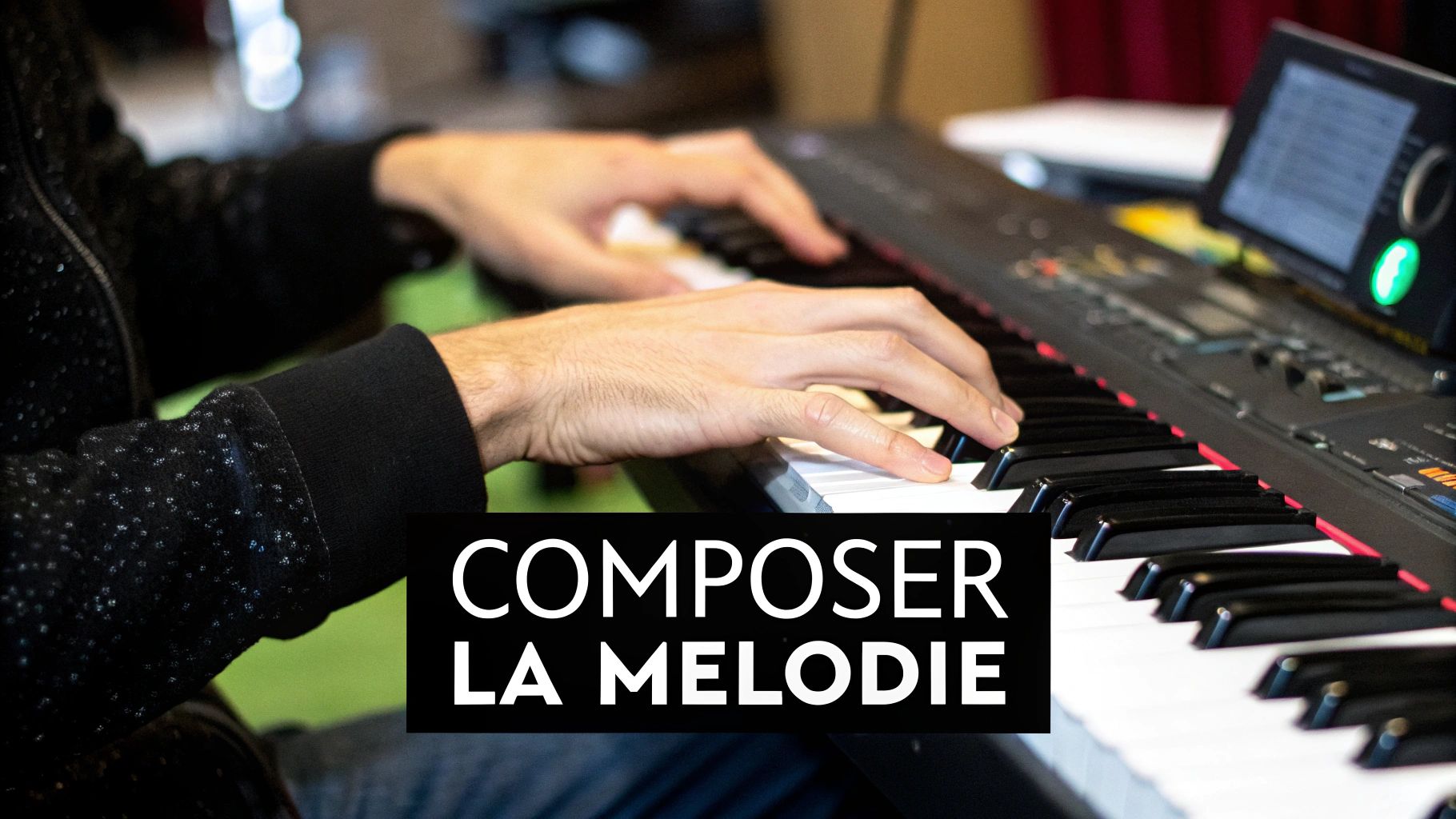
Let's forget the clichés and clichéd statements. Our mission? To paint scenes so real that the listener won't just hear your story, they'll experience it right alongside you.
Show, don't tell
This is the absolute golden rule of writing. Instead of simply naming a feeling, describe the situation that creates it. It's the difference between a simple "I miss you" and words like "your side of the bed is still cold at 3 a.m." The latter is powerful; it creates a powerful image and an immediate connection.
Think of your song as a super-short film. Each verse is a shot, a detail that tells a much bigger story than meets the eye. To pull off this feat, summon all five senses.
- The sight: The color of his eyes in the sun, the glare of a streetlight on the wet sidewalk, a wry smile...
- Hearing: The sound of her laughter echoing, the knowing silence of a morning together, the crackling of the wood fire.
- Smell: The smell of his sweater, the smell of morning coffee, the scent of rain on the asphalt.
- Touch: The warmth of his hand in yours, the softness of a hug, the feel of a familiar fabric.
These little details anchor your lyrics in reality and make them a thousand times more touching. If you want to dig deeper, take a look at our complete guide on how to write song lyrics ; it's full of techniques to sharpen your writing.
The Secret Power of Images and Metaphors
Metaphors are your secret weapon for thinking outside the box. They allow you to translate complex emotions in a poetic and unique way, avoiding the clichés we've all heard too often. Rather than flatly saying "our love is strong," why not try "our love is a beacon in the heart of the storm"? That's immediately more powerful, right?
It's this ability to transform an idea into an image that makes the greatest love songs so powerful. Think of Édith Piaf's "Hymn to Love," which has become a staple of weddings thanks to its universal lyrics about absolute love. Or Celine Dion's "Pour que tu m'aimes encore," a timeless classic that owes everything to its poignant lyrics.
A good metaphor isn't just a pretty phrase. It should fit with your song, reinforcing the main message. It should sound obvious as soon as you hear it.
Rhythm in the skin (of words)
Never forget that your lyrics are meant to be sung. They must therefore have their own music, their own flow, even before a single note of piano or guitar is played. Read your text aloud, again and again. Does it flow? Is the rhythm natural and catchy?
Play around with tones, alliteration (repeated consonants, as in "pour un flirt avec toi"), and assonance (repeated vowels). These little tricks add a unique color and cadence to your lyrics, making them more beautiful to the ear and easier to remember. In fact, well-paced lyrics are the best launching pad for finding the perfect melody . Your lyrics already hum their own tune; you just have to listen.
Melody: the breath that gives life to your words
Your words are there, full of emotion and memories. It's magnificent! Now it's time to give them wings, to find THE melody that will make them take off and anchor them forever in the heart of the other. And believe me, you don't need to be Mozart for that. The secret is listening.
Listen to your own sentences. Read them aloud, over and over again. Do you hear them? There's already a music to them, a natural rhythm, a cadence of their own. This is your starting point, the hidden pulse of your future song.
Dress your emotions with the right chords
Chords are like a painter's palette of colors. They instantly set the tone for your song. Even if you've never studied music theory, understanding their superpower will change everything.
Imagine it like this:
- Major chords (a C, a G, a D...) are bursts of sunshine. They evoke joy, excitement, and optimism. Perfect for a chorus that shouts your happiness or a spirited declaration of love.
- Minor chords (an A minor, an E minor...) are more introspective, tinged with nostalgia, sweetness, sometimes melancholy. They will bring incredible depth to your verses, where you recount more intimate moments.
Don't try to make it complicated! A sequence of two or three chords looping around can be enough to create an incredible atmosphere. What matters is that the color of the chords perfectly matches the emotion of your lyrics.
The melody is the heartbeat of your song. It should embrace every feeling. A soaring melody conveys euphoria, while gently descending notes can evoke a fond memory or a hint of sadness.
Create the impossible-to-forget chorus
The chorus is the fireworks! It's the moment when everything explodes, when the main message is hammered home with passion. Its melody must be self-evident, something that grabs you at first listen and refuses to let go.
The secret? Play with contrast! If your verses are rather calm, almost whispered, make the chorus take off. Dare to go higher, give it more power, create real momentum. It's this depth that will make your song addictive. The verse creates tension, anticipation... and the chorus releases it in the most beautiful way.
Your best ally to not lose anything: your phone!
Inspiration is fickle. It strikes without warning, in the shower, on the bus, in the middle of the night... And an idea for a melody that vanishes is an idea lost forever. Luckily, your smartphone is your best friend!
Always keep something handy to capture those flashes of genius:
- Your phone's voice recorder: It's the simplest and most effective tool. Got a vocal line? Hum it, record it, it's in the box! No fuss.
- Apps like GarageBand or BandLab: These little pocket studios are great. Even if you're not a musician, you can test your voice over a few pre-recorded piano or guitar chords to see if it works.
The goal isn't to create a perfect recording, but to capture the spark. These small, "on the fly" demos will be your memory, your guiding thread for building the song. Your mission is to unearth the music that was already dormant in the depths of your words, the music that seems to have been tailor-made for them.
The Grand Finale: Polish Your Song Like a Pro
There you have it! Your song is here. The lyrics, the melody, all the emotion... It's a rough diamond just waiting to be polished. Now the real work of craftsmanship begins, the work that will transform your magnificent sketch into an unforgettable jewel.
The very first thing to do? Surprisingly... nothing at all! Put your creation aside. Put down your guitar, close your notebook, and forget about it for a day or two. This little break is magical: it allows you to transform from passionate creator to objective listener.
Come back to it with fresh ears. You'll be amazed by what you notice! That word that sounds a little odd, that transition that catches, or that verse that drags on a bit and dilutes the power of the chorus. It's time to get out the scissors and sharpen your work.
The magic of simplification
Often, finalizing is above all the art of pruning. In music, and especially in a love song, the famous "less is more" is a golden rule. Every syllable has its weight. Ask yourself the right questions, without compromise:
- Is every word really essential? Be ruthless! If a word doesn't add to the emotion, it may not belong.
- Does the structure flow naturally? Sometimes, all it takes is reversing two sentences or shortening an intro to make everything clear.
- Is my message clear? The original intention must strike straight to the heart, without detour.
This rewriting isn't a step backward; it's the signature of the pros. It's what makes the difference between a good draft and a song that gives you goosebumps.
A great artist once said that perfection is not achieved when there is nothing left to add, but when there is nothing left to take away. That is exactly the spirit of polishing!
Think about the musical dressing
Once the lyrics and melody are solid, it's time to think about the musical setting. What instrument will best tell your story?
A simple piano can create an incredibly intimate and cozy atmosphere. An acoustic guitar, on the other hand, will bring warmth and immediate proximity. The arrangement is there to enhance the emotion, not drown it out.
Don't be afraid to have one or two people you trust listen to your demo. Choose someone whose judgment is both kind and honest. Their feedback is invaluable. They'll hear things your overly accustomed ear no longer perceives and will help you make those last, all-important decisions.
This finishing step is absolutely crucial. To dig deeper and become a master at it, take a look at our complete guide on how to make a custom song , it's full of other tips to help you.
Need a little help on the road? Your questions, our answers.
The creative journey is a bit like a roller coaster: adrenaline rushes, unexpected turns, and sometimes a little knot in your stomach. That's perfectly normal! Whether you're stumbling over a rhyme or hesitant to pour your heart out, consider this section our final fireside chat to give you that final push.
Stage fright, the fear that it's not "good enough"... We've all been there. But never forget your real goal: it's not to aim for the charts, but to touch the heart of just one person. And that changes everything.
"But... I'm not a musician at all!"
This is THE greatest fear for many people, and yet, it absolutely shouldn't be an obstacle! The music is already there, hidden in the rhythm of your own words. Try a little game: read your text aloud, exaggerating the emotions a little. You'll feel a natural cadence emerge, a sort of spoken melody.
And then there are plenty of ways to cheat a little:
- Magic apps: There are tons of songwriting apps that offer ready-made chord loops. All you have to do is hum along!
- The power of friendship: You're bound to have a friend who strums a guitar or taps a piano, right? Ask them to bring your lyrics to life. It's often the start of a great collaboration.
The idea is to find a melody that carries your message, even if it's super simple. Believe me, sometimes two or three well-chosen notes can create incredible magic.
“What if my song is way too personal?”
But that's exactly what will make it incredible! Your song is a gift, and its greatest strength is that it's yours . The most intimate emotions are paradoxically those that speak the most to others. By daring to speak about what you feel with total honesty, you're not building a wall, but a real bridge.
Your story, with its little details that only you know, becomes a mirror. It's your vulnerability that will create the connection. It's your greatest asset.
Never be afraid to be too specific. You don't touch someone by talking about "love" in general. You touch them by describing the way their hair frames their face on a rainy Tuesday morning. The universal is always in the details.
"How do I avoid falling into all the clichés of love songs?"
Your best weapon against clichés is your memory. Avoid clichés like the plague and go treasure hunting in your memories. Instead of saying, "Your eyes shine like stars," recall that exact moment when you saw the reflection of the city lights in his eyes.
Authenticity is found in the little imperfections, the jokes only you understand, the adorable quirks that make up your daily life. Tell a true story, your story. By definition, it will be unique and light years away from clichés.
Ready to turn your story into a melody that will last forever? At YourMelody , our artists are passionate about transforming your feelings into a 100% tailor-made song. It's more than a gift; it's an emotion that will resonate forever. Find out how to create your personalized song at yourmelody.org .